
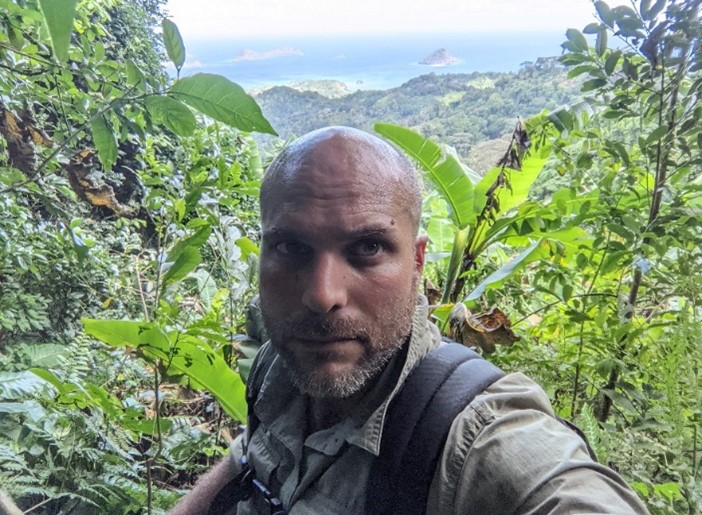
Senior Lecturer in Conservation Science
Mark.Abrahams@uwe.ac.uk
I am an interdisciplinary, applied conservation scientist, mainly focusing on community-based conservation in the rural humid tropics. I view community-based natural resource management as an important nexus of both food sustainability and decolonising conservation. I am involved in research and conservation projects regarding the biodiversity implications of cocoa production in Madagascar and subsistence hunting, community-based fisheries management, and conflicts arising from crop foraging in the Brazilian Amazon. Between my work for the Bristol Zoological Society, Instituto Juruá, and REDD+ agroforestry projects, I have pan-tropical field experience. I use mixed research methods including Geographic Information Systems, qualitative and quantitative interviews, camera trapping, and more recently invertebrate DNA sampling.
Publications
- Francolini, E.M., Mann-Lang, J.B., McKinley, E., Mann, B.Q. and Abrahams, M., 2023. Stakeholder perspectives on socio-economic challenges and recommendations for better management of the Aliwal Shoal Marine Protected Area in South Africa. Marine Policy, 148, p.105470.
- Quintero, S., Abrahams, M., Beirne, C., Blake, J., Carvalho Jr, E., Costa, H.C., de Paula, M.J., Endo, W., Haugaasen, T., Lima, M.G.M. and Michalski, F., 2023. Effects of human-induced habitat changes on site-use patterns in large Amazonian Forest mammals. Biological Conservation, 279, p.109904.
- Alley, C.L., Arkless, S., Ames, E., Abrahams, M., Gentle, L.K. and Wood, M.J., 2022. Plastic ingestion in adult and fledgling Manx Shearwaters Puffinus puffinus on Skomer Island, Wales. Seabird, 34.
- Antunes, A.C. et al., 2022. Amazonia CAMTRAP: A data set of mammal, bird, and reptile species recorded with camera traps in the Amazon forest. Ecology, 103(9). Available at: https://doi.org/10.1002/ecy.3738.
- Sampaio, R., Morato, R., Abrahams, M., Peres, C. and Chiarello, A., 2022. Physical geography trumps legal protection in driving the perceived sustainability of game hunting in Amazonian local communities. Journal for Nature Conservation, 67, p.126175.
- Campos-Silva, J., Peres, C., Hawes, J., Abrahams, M., Andrade, P. and Davenport, L., 2021. Community-based conservation with formal protection provides large collateral benefits to Amazonian migratory waterbirds. PLOS ONE, 16(4), p.e0250022.
- Alexander, E., Abrahams, M. and Clark, F., 2021. Bottlenose Dolphins Produce Underwater Bubbles Linked to Cognitive Task Engagement but Not Success. Journal of Zoological and Botanical Gardens, 2(2), pp.287-299.
- Downey, H. et al., 2021. Training future generations to deliver evidence‐based conservation and ecosystem management. Ecological Solutions and Evidence, 2(1).
- Mynott, H., Abrahams, M., and Kerhoas, D., 2021. Negros Bleeding-heart Gallicolumba keayi prefers dense understorey vegetation and dense canopy cover, and species distribution modelling shows little remaining suitable habitat. Bird Conservation International. Cambridge University Press, 31(4), pp. 640–655. doi: 10.1017/S0959270920000611.
- Rocha, D., de Barros Ferraz, K., Gonçalves, L., Tan, C., Lemos, F., Ortiz, C., Peres, C., Negrões, N., Antunes, A., Rohe, F., Abrahams, M., Zapata-Rios, G., Teles, D., Oliveira, T., von Mühlen, E., Venticinque, E., Gräbin, D., Mosquera B., D., Blake, J. and Lima, M., 2020. Wild dogs at stake: deforestation threatens the only Amazon endemic canid, the short-eared dog (Atelocynus microtis). Royal Society Open Science, 7(4), p.190717.
- Webber, A., Solofondranohatra, J., Razafindramoana, S., Fernández, D., Parker, C., Steer, M., Abrahams, M. and Allainguillaume, J., 2019. Lemurs in Cacao: Presence and Abundance within the Shade Plantations of Northern Madagascar. Folia Primatologica, 91(2), pp.96-107.
- Kerhoas, D., Poole, J. and Abrahams, M., 2019. A systematic survey for the Critically Endangered Negros Bleeding-heart Gallicolumba keayi in the Northwest Panay Peninsula Natural Park, Philippines. BirdingAsia. 32. 50-56.
- Wang, B., Rocha, D., Abrahams, M., Antunes, A., Costa, H., Gonçalves, A., Spironello, W., de Paula, M., Peres, C., Pezzuti, J. and Ramalho, E., 2019. Habitat use of the ocelot (Leopardus pardalis) in Brazilian Amazon. Ecology and Evolution, 9(9), pp.5049-5062. https://doi.org/10.1002/ece3.5005
- Lima, M., Peres, C., Abrahams, M., Silva Junior, C., Costa, G. and Santos, R., 2019. The paradoxical situation of the white-lipped peccary (Tayassu pecari) in the state of Mato Grosso, Brazil. Perspectives in Ecology and Conservation, 17(1), pp.36-39.
- Abrahams, M., Peres, C. and Costa, H., 2018. Manioc losses by terrestrial vertebrates in western Brazilian Amazonia. The Journal of Wildlife Management, 82(4), pp.734-746.
- Costa, H., Peres, C. and Abrahams, M., 2018. Seasonal dynamics of terrestrial vertebrate abundance between Amazonian flooded and unflooded forests. PeerJ, 6, p.e5058.
- Abrahams, M., Peres, C. and Costa, H., 2017. Measuring local depletion of terrestrial game vertebrates by central-place hunters in rural Amazonia. PLOS ONE, 12(10), p.e0186653.